
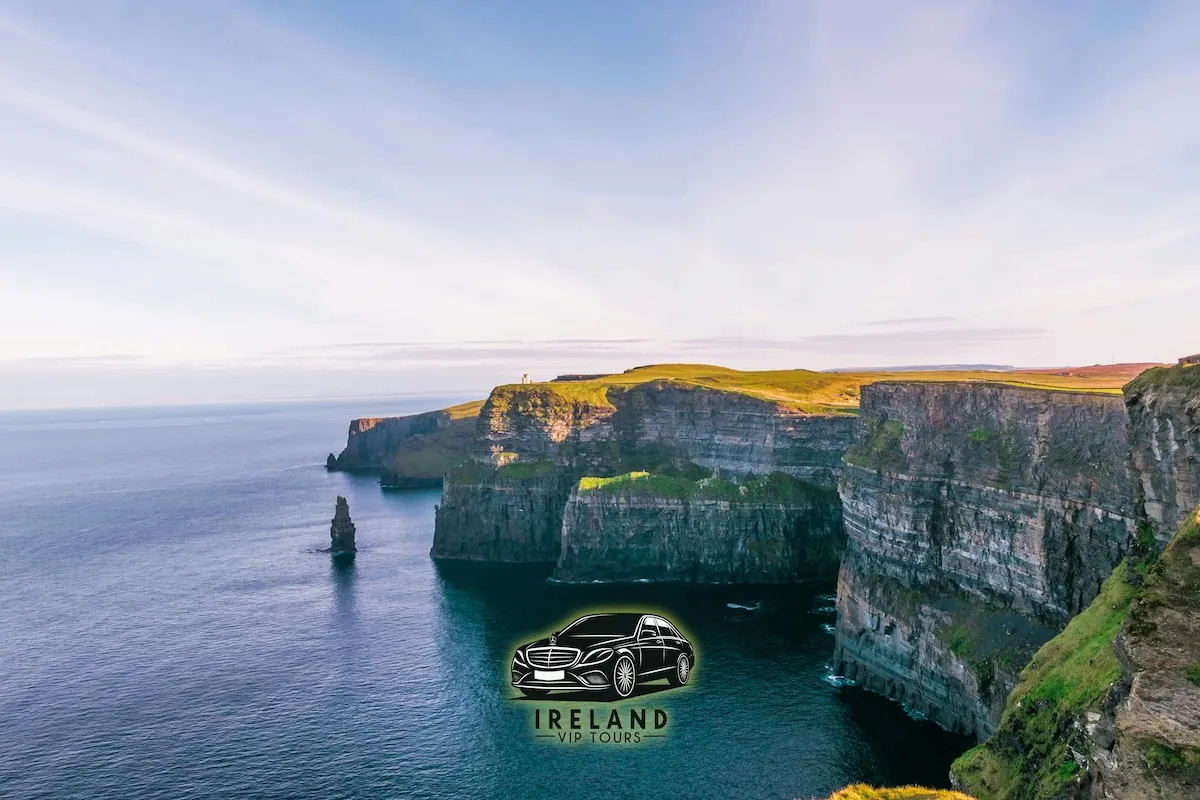
The Cliffs of Moher: Complete Guide to History, Wildlife & Visiting
18 June 2026
Book a Private Tour of Ireland
Imagine standing on the edge of the world, where the wild Atlantic crashes against towering cliffs stretching into the horizon. This is the Cliffs of Moher — one of Ireland’s most breathtaking natural wonders and the single most visited attraction in the country, welcoming over 1.5 million visitors each year.
A Geological Marvel 320 Million Years in the Making
The Cliffs of Moher stretch 14 kilometres along County Clare’s Wild Atlantic Way coast, rising 214 metres (702 feet) above the Atlantic at their peak near O’Brien’s Tower. Their story begins 320 million years ago — and it starts not in Ireland, but near the equator.
During the Upper Carboniferous period, what we now call Ireland sat 6,000 miles to the south, just north of the equator, battered by heavy monsoon rains comparable to the modern-day tropics. The area where the Cliffs now stand was the vast delta of several massive rivers — think the scale of the Ganges — streaming down from mountains to the south.
These rains eroded the mountains upstream, and the rivers carried thousands of tonnes of mud, sand, and sediment toward the delta. Heavier, coarser materials gathered near the shoreline while finer sediments were carried further out to sea. This raised the seabed, pushed out the shoreline, and created new fertile land — which was then populated with flora. Then the sea level rose again, water covered the land, and new sediment layers were deposited on top. This cycle repeated over millions of years, creating the distinct strata — the striking bands of shale, siltstone, and sandstone — visible today in the cliff face.
Sea stacks like Branaunmore, a towering pillar eroded from the mainland, add further drama to the scene. The Cliffs’ designation as part of the Burren and Cliffs of Moher UNESCO Global Geopark (recognised in 2011, one of only three UNESCO Geoparks in Ireland) underscores their geological significance and promotes sustainable conservation.
A Historical Landmark
The Cliffs are not only a natural spectacle — they are steeped in human history. Their name derives from an old Gaelic word, “Mothar” or “Moher”, meaning “the ruin of a fort” — a nod to a promontory fort that once stood at Hag’s Head, the southernmost tip. This Iron Age structure, around 2,000 years old, was demolished during the Napoleonic Wars to make way for a signal tower.
In 1835, Sir Cornelius O’Brien — a local landowner and descendant of the legendary High King Brian Boru — built O’Brien’s Tower as an observation point for visitors. He believed tourism could lift the local economy out of poverty, making him a visionary far ahead of his time. The tower remains a beloved vantage point, offering panoramic views of the Aran Islands, Galway Bay, the Maumturks and Twelve Pins mountains, and on clear days, the Dingle Peninsula.
The Cliffs were recognised as an official Refuge for Fauna in 1988, and later designated a Special Protection Area under Irish and EU wildlife legislation — the first formal recognition of their extraordinary ecological importance.
Legends That Whisper on the Wind
Irish folklore weaves tales of enchantment and tragedy into the Cliffs’ craggy edges.
The most famous story centres on Hag’s Head, where a rock formation resembles a woman gazing out to sea. This is Mal — a hag or witch hopelessly in love with the great Irish hero Cú Chulainn. When he spurned her, she chased him across all of Ireland to Loop Head in County Clare. Thinking she had finally cornered him, she watched in despair as Cú Chulainn leapt back to the Cliffs of Moher. Mal followed, but the winds betrayed her, dashing her against the rocks at Hag’s Head — where her silhouette remains frozen in stone to this day.
Another tale speaks of Kilstiffen — a lost city said to lie submerged beneath the waves near the Cliffs. According to legend, the town sank when its chieftain lost a golden key to the castle, doomed to remain underwater until the key is recovered. Some claim to glimpse its rooftops on particularly calm days; others say it rises every seven years — though anyone who sees it is fated to die before its next appearance.
A Wildlife Haven of National Importance
Beyond their dramatic vistas, the Cliffs of Moher are a thriving ecosystem. Designated a Special Protection Area for birds, they host one of Ireland’s largest mainland seabird colonies with over 30,000 nesting pairs — and the populations are extraordinary in their scale and diversity.
Puffins: The Cliffs are home to the largest puffin population in Ireland, with more than 1,400 individuals in their colony. Their colourful beaks and waddling charm make them a delight for visitors from late March.
Guillemots: Almost 20,000 guillemots gather and make the Cliffs their nesting place each year, arriving around March/April.
Kittiwakes: One of the first species to return each spring, numbering close to 10,000 birds — one of Ireland’s largest kittiwake colonies.
Razorbills and Fulmars: Razorbills nest on the overhanging sandstone ledges. Fulmars arrived around 1911 and have returned every year since to nest on the ledges they first discovered over a century ago.
On lucky days, you might spot dolphins, seals, or even basking sharks gliding through the waters below, while hares and feral goats roam the cliff tops above.
The Burren and Cliffs of Moher UNESCO Geopark team runs extensive training and educational conservation programmes throughout the year, managing this delicate ecosystem while maintaining an excellent visitor experience.
A Star on the Silver Screen
The Cliffs of Moher’s cinematic allure is undeniable. In The Princess Bride, they became the legendary “Cliffs of Insanity”. Harry Potter and the Half-Blood Prince transformed them into the haunting Horcrux cave. The Mackintosh Man (1973) and Into the West (1992) immortalised them on film. Even the beloved Irish sitcom Father Ted staged a memorable scene with the cliffs as backdrop. These appearances cement the Cliffs as a cultural icon recognised worldwide.
For film location fans on a private tour of the Cliffs of Moher, your chauffeur-guide can point out the exact spots used in each production.
What to See Beyond the Cliffs
The Burren: Just inland from the Cliffs lies the Burren — an otherworldly limestone moonscape dotted with wildflowers found nowhere else in Ireland, and ancient megalithic tombs including Poulnabrone Dolmen, a 5,500-year-old portal tomb that predates Stonehenge.
Doolin Cave: Below ground, the spectacular Doolin Cave contains the longest free-hanging stalactite in the northern hemisphere — a jaw-dropping natural wonder just minutes from the cliff edge.
Doolin Village: The spiritual home of traditional Irish music, Doolin hosts live sessions year-round. From Doolin Pier, ferry rides run beneath the Cliffs from sea level — giving you a completely different perspective, with 700 feet of rock towering overhead like nature’s own cathedral.
The Cliff Walk: The 18-kilometre walk from Doolin to Liscannor winds along the cliff edge, offering heart-pounding views and the raw power of the Atlantic wind. Sections of the walk offer perspectives no viewing platform can replicate.
The Modern Visitor Experience
The Cliffs of Moher Visitor Experience (opened 2007) blends seamlessly into the hillside with eco-friendly design — geothermal heating, solar panels, and a minimal footprint. Inside, interactive exhibits explore the geology, wildlife, and history of the Cliffs, while a virtual reality “Cliffs Adventure” lets you soar over the edge without leaving the ground.
Opening hours: Visitor Centre 9:00 AM – 6:00 PM (extended summer hours to 9 PM in peak season) Admission: Included in car parking charge (free for walkers)
The Puffins Nest Café and Cliffs View Café offer warm Irish fare — seafood chowder, beef pie, and hot drinks — with views over Liscannor Bay. Paved pathways stretch 800 metres from the visitor centre to viewing platforms and O’Brien’s Tower. A buggy assists less mobile visitors.
When to Visit
Spring (May–June): Mild weather, blooming wildflowers, and peak bird activity — ideal for nature lovers and photographers.
Summer: Extended opening hours, maximum daylight, but the largest crowds. Go early morning (before 10 AM) or late afternoon to avoid coach tour groups.
Autumn: Moody skies, dramatic storm light, and far fewer tourists — perfect for photographers chasing atmosphere.
Winter: Windswept and raw. Witness the Cliffs’ true power as Atlantic storms send waves crashing against the rock face below.
Visit the Cliffs with a Private Chauffeur
Our Cliffs of Moher Private Chauffeur Tour from Dublin includes the Cliffs, the Burren, and Bunratty Castle — a full day of the west of Ireland’s finest sights in complete luxury. Extend to two days with our Galway 2-Day Tour to add the city of Galway and Connemara.
The Cliffs of Moher are more than a destination — they are a living storybook of geology, mythology, wildlife, and human history. Every gust of wind feels like a whisper from Ireland’s ancient past.
Founder & Lead Driver-Guide, Ireland VIP Tours
John is the founder of Ireland VIP Tours and an experienced professional chauffeur-guide based in Dublin. With over 15 years in the luxury tour industry, he has personally guided thousands of visitors across Ireland, sharing local stories, hidden gems, and insider knowledge that only a native guide can offer.