
The Blarney Stone: History, Myths, Legends & Visitor Guide
18 June 2026
Book a Private Tour of Ireland
Ireland is full of locations that conjure puzzling mystery out of outstanding beauty. No location does this more than Blarney Castle, Co. Cork — home to the world-famous Blarney Stone. This post covers the complete history, the myths, the legends, and everything you need to know before your visit.
The Stone of Eloquence
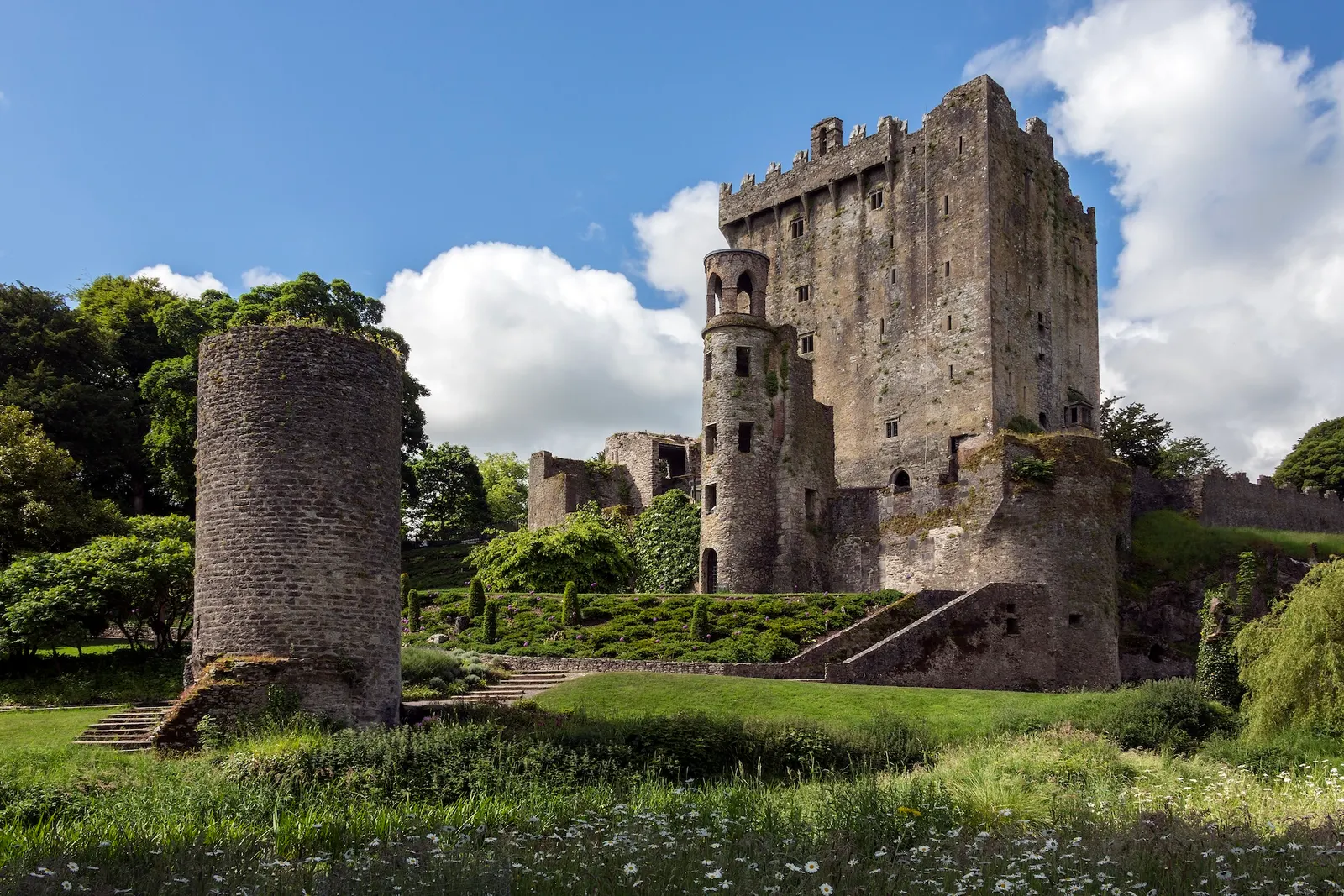
You can find the Blarney Stone (Cloch na Blarnan in Irish) slotted into the battlements of Blarney Castle, just 8 miles from Cork City. This unassuming limestone block is one of Ireland’s most famous attractions, known all over the world. Its mythical status — the legendary “gift of the gab” — makes it a must-see for any visitor to Ireland.
The Castle itself is a stone tower house, a typical fortification built by medieval Irish lords. The site was occupied from at least the 10th century, first as a wooden structure, then a stone fortification around 1210, before the current castle was erected by the MacCarthy of Muskerry dynasty in 1446. It was subsequently inhabited by Cormac “Laidir” MacCarthy (Cormac “the Strong”) when he became King of Munster.
The Gift of the Gab — How Did It Begin?
Like the origin of the stone itself, the origin of the “gift of the gab” legend is unclear, with several compelling versions.
The Queen of the Fairies: Clíodhna
The most enduring myth ties the Blarney Stone to Clíodhna (Clio-na), the Celtic goddess of love and beauty — Queen of the Munster Fairies. According to local lore, Cormac MacCarthy faced a serious legal dispute threatening his castle and lands. In desperation, he sought the aid of the fairy folk who dwelled in the nearby woods.
Clíodhna appeared to him in a dream. She had been spurned by a lover who was later killed in battle. His body lay in a river, resting on a rock. When Clíodhna found him, she wept and kissed him endlessly in grief — her tears, kisses and love had passed some of her powers into the rock. She advised Cormac from the otherworld to find this rock and kiss it, and he would be bestowed with the gift of clear, convincing, eloquent speech.
He followed her instructions. He won the difficult court case, convincing the judge with extraordinary eloquence. The stone, said to have been set into the castle’s battlements as a gift from Clíodhna, retains her magic to this day. On quiet nights near the castle, some claim to hear her haunting song drifting on the wind.
Bannockburn and the Stone of Scone
Ireland had elaborate systems of nobility, lordships, and international alliances. One was a strong bond between Cormac MacCarthy and Robert the Bruce of Scotland.
As part of this alliance, Cormac supported the Scotsman by providing 5,000 infantrymen for the Battle of Bannockburn against English King Edward I in 1314. In return, Robert gave a piece of the Stone of Scone — used in the first coronation of a Scottish King in 847 — to Cormac. This fragment was installed in Blarney Castle’s battlements.
A 1980s geological analysis found traces of Scottish mineral content in the stone, lending some weight to this story. However, a separate study by geologists from Glasgow University found its signature matched limestone from the southwest of Ireland. The mystery deepens.
Elizabeth I and the Word “Blarney”
Queen Elizabeth I tried for years to gain control of Blarney Castle and its surrounding lands — she wanted to remove the MacCarthys’ land rights entirely.
But Cormac Teige MacCarthy, empowered with his gift of eloquence, was able to talk her out of it repeatedly — flooding her messengers with flattery, feasts, and impossible-to-refuse words. Exasperated, the Queen dubbed his beguiling, evasive speech “Blarney” — and the word entered the English language forever as meaning persuasive, elaborate, and charming nonsense.
Eastern Origins
Even more exotic theories exist. Some say the stone is the Stone of Ezel where the Jewish King David hid from Saul, brought back to Ireland after the English Crusades in the Holy Lands. Others have suggested it was the same stone Moses struck to provide water for the Israelites after they escaped Egypt. These make fascinating stories — though they are likely just that.
The Deeper Mythology: Druids, Fairies and Mermaids
The Druid’s Curse — Fintan’s Stone
A darker mythological thread links the Blarney Stone to Ireland’s druids — the ancient priestly class said to wield powerful magic before Christianity arrived. Legend holds that the stone was once part of a sacred druidic altar, imbued with wisdom and foresight. When the druids were displaced, they cursed the stone, binding its magic only to those who proved their worth — hence the precarious position of the stone, requiring visitors to lean backward over a dizzying drop.
This tale centres on a druid named Fintan, who hid the stone in the castle to protect it from invaders. Fintan is said to have transformed into a salmon to escape his enemies — a common motif in Celtic mythology — and his spirit is believed to guard the stone to this day. A small ring of stones in the castle grounds, known as the Druid’s Circle, is said to be where Fintan performed his rituals. Local custom says leaving a small offering there earns his blessing rather than his curse.
The Fairy Bargain — Tuatha Dé Danann
One enchanting myth ties the stone to the fairy folk — Ireland’s mythical inhabitants of the Otherworld. One tale claims the stone fell from the sky during a battle between the Tuatha Dé Danann (Celtic gods) and the invading Milesians, landing in a fairy ring near Blarney Castle. The fairies struck a bargain with Cormac MacCarthy: he could use the stone’s power if he preserved their sacred spaces on the estate.
This connection is reinforced by the Rock Close — a mystical garden near the castle where fairy forts, caves, and ancient yew trees create an otherworldly atmosphere. Locals say that on Midsummer’s Eve, the fairies dance around the Blarney Stone, and those who linger nearby might catch a glimpse of their ethereal forms.
The Mermaid’s Kiss
A lesser-known myth adds a romantic twist. A fisherman living near the River Lee fell in love with a mermaid, who could only stay on land if she found a token of eternal love. She offered him a kiss from a magical stone — promising it would bind their hearts forever. The fisherman broke his vow, and the mermaid returned to the sea, leaving the stone behind — later incorporated into Blarney Castle. Some say kissing the stone carries a trace of her longing, making words more poignant and heartfelt.
Cromwell, Rebellion and Resilience
Blarney Castle endured turbulent times. In 1646, during the Irish Confederate Wars, Oliver Cromwell’s forces besieged the fortress. Though the castle eventually fell, the stone remained intact — a silent witness to the McCarthys’ defiance. The family’s fortunes waned under English rule, but the stone’s legend grew, whispered among locals as a source of resilience and cunning in the face of oppression.
By the 18th century, the castle passed out of McCarthy hands, sold to the Jefferyes family in 1703 after the Williamite War. Yet the stone’s allure persisted, drawing antiquarians and curious travelers. Early visitors described lowering themselves precariously over the parapet without safety bars or guides — the formal kissing ritual evolved organically from local folklore rather than any planned attraction.
The Modern Era: From Folklore to Global Fame
The Blarney Stone’s transformation into a world-famous tourist icon began in the 19th century, fuelled by the Romantic movement’s fascination with Celtic heritage. Writers like Sir Walter Scott and travelers from Britain and America spread tales of its magic. Iron railings were eventually added to assist visitors, formalizing the kissing ritual. The Colthurst family, who acquired the estate in 1846, further developed the attraction.
The stone’s fame exploded in the 20th century through mass tourism. Winston Churchill kissed it in 1912. Mick Jagger, Stan Laurel, and countless politicians, royals, and celebrities have made the pilgrimage since. Today, over 300,000 people annually climb Blarney’s narrow spiral stairs to plant a kiss on the weathered limestone.
Controversies and Mysteries
The Blarney Stone has its share of detractors. Skeptics question which stone is the “real” one — some claim the true relic is hidden elsewhere on the grounds. Others raise hygiene concerns, though the stone is regularly sanitised. A 2014 viral rumour alleged the stone was once part of a medieval latrine — a claim thoroughly debunked by historians, but gleefully repeated by cynics.
Science has also weighed in. A geological study confirmed the stone’s local limestone origins, challenging the Scottish connection. Meanwhile, the ritual’s unusual upside-down orientation remains unexplained — some speculate it mimics an ancient initiation rite; others say it’s simply a practical consequence of the stone’s awkward position in the parapet wall.
Visiting the Blarney Stone: What to Expect
The Climb and the Kiss
To kiss the Blarney Stone, you’ll climb over 100 narrow spiral steps to the castle’s battlements. At the top, the views across 60 acres of gardens are pure Irish poetry. Then comes the main event: lie back over a dizzying drop, grip the iron safety bars, and lean down to plant your lips on the ancient limestone — trusty guides keeping you safe throughout.
It’s part thrill, part hilarity, and completely unforgettable. You’ll leave with the gift of eloquence — or at least a great story.
The Castle Grounds
Blarney Castle is far more than just the stone. Explore:
- The Dungeons — shadowy underground chambers from the 15th century
- The Murder Room — where hot oil was poured on unwelcome guests (Irish hospitality at its finest)
- The Poison Garden — home to wicked plants including wolfsbane and ricin, labelled with their dark histories
- The Wishing Steps — where local tradition says walking backwards down the steps with eyes closed might grant your deepest wish
- The Rock Close — a mystical garden of ancient yew trees, fairy forts, and druidic stone formations
Practical Information
The Blarney Castle and Rock of Cashel Private Chauffeur Tour from Dublin combines Blarney with the magnificent Rock of Cashel — two of Ireland’s most dramatic heritage sites in one exceptional day. Book Blarney Castle admission in advance at blarneycastle.ie to guarantee your slot, especially in summer.
What Are the Real Geological Facts?
The Blarney Stone is a piece of carved Carboniferous Limestone, approximately 330 million years old. A group of geologists from Glasgow University ran tests on the stone and found that its signature matched other limestone from the southwest of Ireland — lending weight to the theory that the stone was taken to Scotland with Cormac’s troops, then returned by Robert the Bruce.
Beyond that, the story becomes shrouded in unsolvable myth and magic — like so much else on this wonderful green island.
Founder & Lead Driver-Guide, Ireland VIP Tours
John is the founder of Ireland VIP Tours and an experienced professional chauffeur-guide based in Dublin. With over 15 years in the luxury tour industry, he has personally guided thousands of visitors across Ireland, sharing local stories, hidden gems, and insider knowledge that only a native guide can offer.